
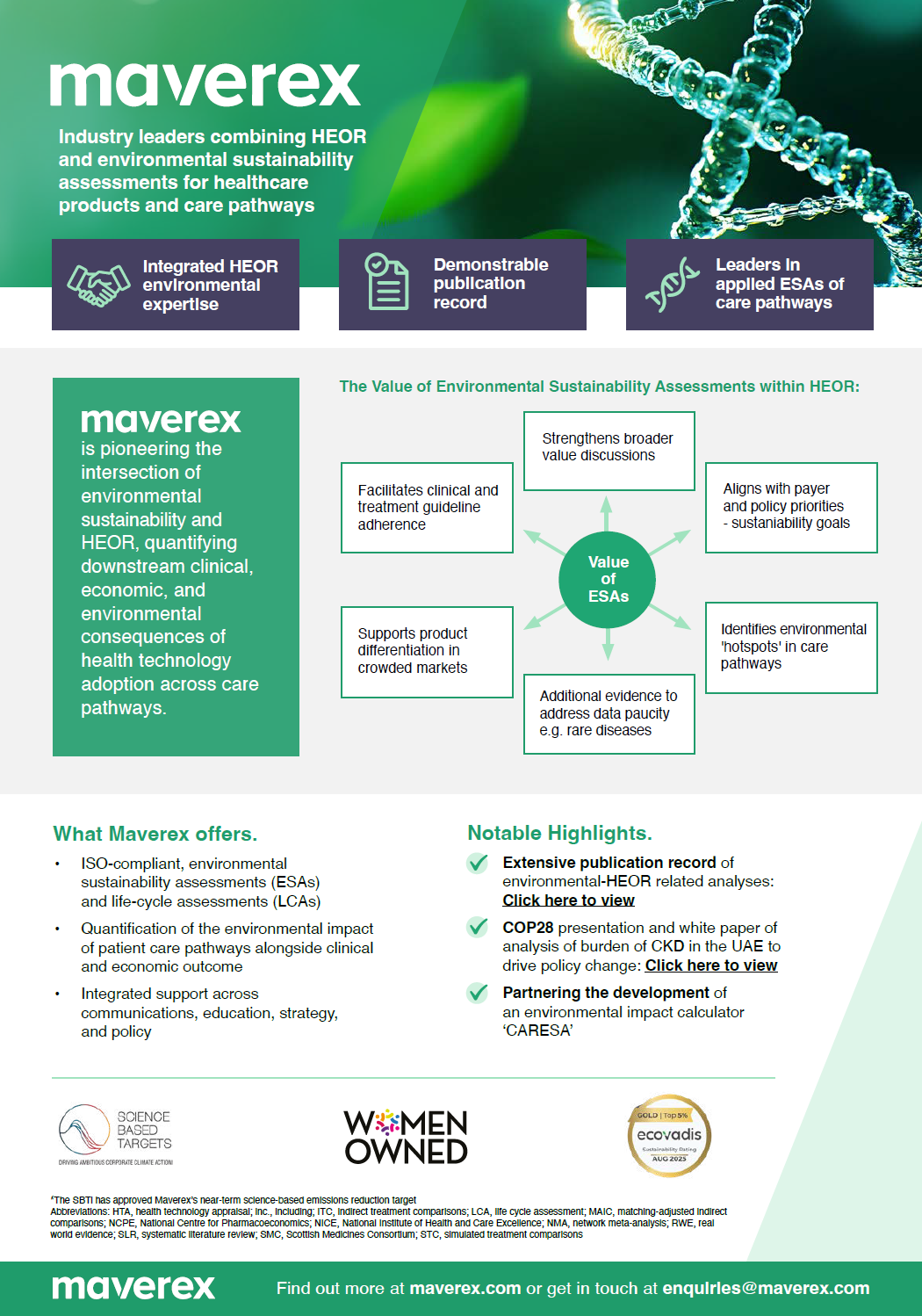
At Maverex, we are uniquely positioned to support your environmental and sustainability goals in product development.
With the rising environmental cost of healthcare, governments and national societies are implementing strategies to mitigate greenhouse gas (GHG) emissions.
We can help you distinguish yourself from the field and integrate environmental knowledge into your pipeline.
Environmental Sustainability Assessments


What We Offer
We are ready to support your environmental and sustainability goals in product development

Environmental Sustainability Assessments
Our Environmental Sustainability Assessments (ESAs) demonstrate the combined health and environmental benefit of your product, process or treatment pathway. These assessments:
Inform future product development
Support HTA submissions
Align with net zero and sustainability goals
Life Cycle Assessments
Some HTA agencies in the near future will include a requirement to assess and present the environmental impact of a new intervention. We can support the inclusion of an environmental assessment into a products market access strategy and subsequently into the value communications and evidence requirements of HTAs.
Holistic Focus
Traditional ESAs in healthcare have focused on facilities and individual products, overlooking the broader impact of care delivery, which together account for around 40% of healthcare-related GHG emissions. A care pathway perspective captures the full environmental footprint of clinical decisions and interventions, revealing opportunities to redesign services that enhance both patient outcomes and sustainability.
ESAs and Market Access
While not yet a formal HTA requirement, agencies like such as National Institute of Health and Care Excellence (NICE; England), Canada’s Drug Agency (CDA-AMC), Haute Autorité de Santé (HAS; France), and Zorginstituut Netherlands (ZIN) are exploring ways to integrate environmental sustainability. Including ESAs in HTA submissions broadens value assessments, and we support embedding environmental impact into market access strategies, value communication, and evidence frameworks.

Who We Are
A team of experienced professionals, focused on high-quality solutions and a commitment to environmental responsibility.
A broad, global reach and strategic collaborations.
We have strong collaborations with other partnerships, including leading environmental experts, major pharmaceutical companies and the Sustainable Markets Initiative (SMI), through which we are developing CARESA, a pioneering tool used to model the environmental impact of patient care pathways. What’s more, our work has global reach through publications and conferences (e.g., United Nations Climate Change Conference), influencing policy changes at the local and national level.

Examples of our expertise
Maverex have expertise across the key areas required to support successful delivery of environmental impact projects. These include:
Integrated environmental and economic modelling
Software application development
Economics and reimbursement strategy
Scientific communication
Evidence synthesis
Data analysis

Case Study:
Semaglutide Environmental Impact
Overview: We investigated how introducing semaglutide, a GLP‑1 receptor agonist, may impact greenhouse gas (GHG) emissions associated with downstream healthcare resource use (HCRU) in adults in England living with obesity and type 2 diabetes (T2D).
Problem: More than two-thirds of adults in England are overweight or living with obesity. Obesity increases the risk of comorbidities such as T2D, which drives higher HCRU through increases in GP appointments, hospital admissions, and prescription use. Higher HCRU not only increases system pressures but also leads to greater GHG emissions. Semaglutide has been shown to reduce body mass index (BMI) by around 15% and to improve a range of cardiometabolic risk factors within 68 weeks. These improvements have the potential to decrease the need for downstream care.
Approach: We conducted an environmental sustainability assessment (ESA) to quantify annual CO₂e emissions resulting from HCRU among adults in England with T2D and a BMI ≥30.
The analysis compared two scenarios:
Standard care without semaglutide
Standard care with semaglutide, applying a 15% BMI reduction based on clinical evidence
Key Findings: Shifting patients to lower BMI categories, reflecting the average reduction achieved with semaglutide, resulted in meaningful decreases in healthcare demand.
A 15% reduction in BMI led to a 7% decrease in total healthcare-related GHG emissions over one year.
Our analysis highlights how shifts towards lower BMI distributions, driven by semaglutide, could reduce HCRU and, in turn, lower healthcare-related emissions, whilst supporting NHS net-zero targets.
Much More to Maverex
Experts in demonstrating product value, from clinical development to post-launch commercialisation.

-
Explore our latest peer-reviewed research publications, across nutrition, disease, the environment, market access and much more.

-
We take a personal approach to every project, and enjoy fantastic feedback from our clients as a result. Discover what they have to say about us on the Testimonials page.